
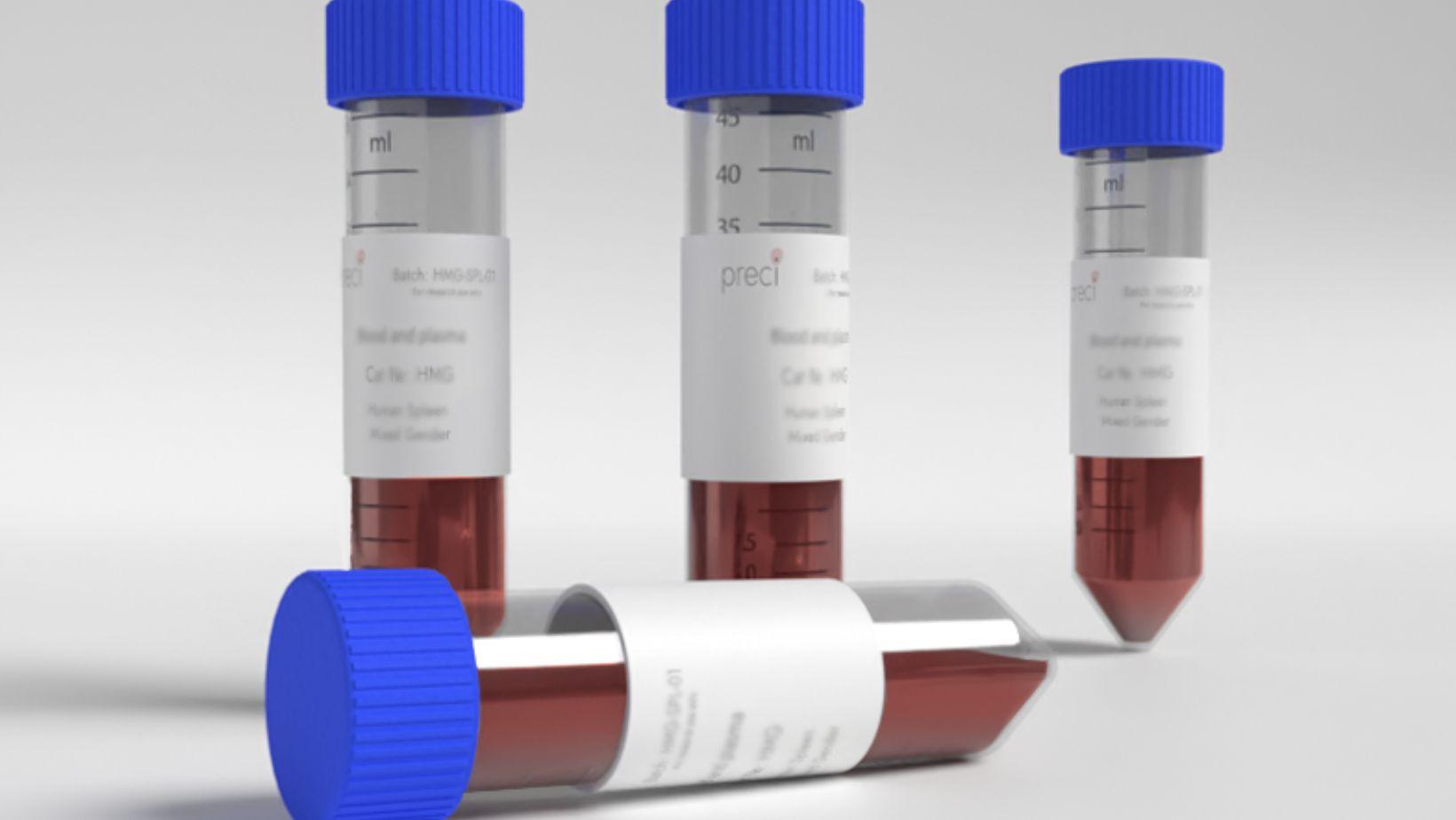
Every tube of blood contains a potential error that can ruin months of laboratory work. Improper sample collection alone can produce hemolyzed plasma, which can distort the results of proteomic, lipidomic, and metabolomic analyses. This is one of the challenges Preci addresses when providing validated biospecimens and human cell models for preclinical research.
Table of Contents
Why Hemolysis Remains a Challenge for Quantitative Analysis
Hemoglobin, released into plasma during red blood cell breakdown, adds several to ten grams of extraneous protein per liter to the sample. This alters the ratio of target analytes and interfering components, leading to biased results from mass spectrometric and chromatographic methods.
Researchers face an even greater challenge because they cannot always detect mild hemolysis visually, and different biomarker classes respond to it in different ways. In clinical studies with large numbers of participants, even a small proportion of such samples can bias the statistical analysis of the entire sample and call into question the reliability of the identified patterns.
Which Measurements Are Most Susceptible?
Hemolysis affects not only the overall protein concentration but also the specific analytical parameters that researchers use to interpret the results. Hemolysis affects not only the overall protein concentration but also several key analytical parameters, including:
- distortion of the circulating microRNA profile;
- overestimation of protein biomarker concentrations;
- changes in lipidomic and metabolomic composition;
- errors in chromatographic separation of the analyte;
- appearance of false positive signals;
- loss of reproducibility between sample batches.
Each of these effects can independently influence the study’s conclusions. Their combination makes data interpretation particularly challenging for teams working with a limited number of donor samples.
Projects searching for new biomarkers are particularly sensitive to such biases, as the statistical significance of the result directly depends on the homogeneity of the original sample.
How Laboratories Reduce the Risk of Hemolysis
Hemolysis cannot be eliminated. However, most laboratories develop procedures that minimize their impact during blood collection and processing.
This approach requires discipline at every step of the supply chain, as well as a willingness to revise protocols if a new batch of samples exhibits atypical behavior during analysis:
- visual assessment of the degree of hemolysis;
- direct venipuncture instead of a catheter;
- rapid and accurate centrifugation;
- temperature control during transportation;
- validation of methods on hemolyzed samples;
- sample dilution if the effect is confirmed;
- recording the hemolytic index in the protocol.
These measures do not eliminate variability in biological material. Still, they allow laboratories to understand in advance which batches of samples are suitable for quantitative analysis and which require additional verification.
In the long term, this discipline saves the research team time and reduces the number of experiments that must be repeated due to poor-quality material.
The Role of the Biospecimen Supplier in Reducing Variability
The quality of the starting material determines the reproducibility of subsequent analysis. Since 2020, Preci has been building a network of clinical sites that regularly supply human biospecimens. It subjects each batch to quality control before shipment to the laboratory. This applies to both liver cells for ADMET studies and tumor models for oncology.
End-to-end quality control means researchers receive samples with pre-documented characteristics. This makes it easier to plan experiments and to reduce the number of duplicate measurements. Such an approach helps reduce pre-analytical variability by providing well-characterized biospecimens and documented quality control data.
Hemolysis remains one of the most underestimated sources of error in quantitative research. It affects biomarker levels, analyte stability, and batch-to-batch reproducibility. This risk is mitigated by combining strict laboratory protocols and high-quality starting biomaterials.
The earlier a team considers the possibility of hemolysis when planning an experiment, the less time and resources are spent on repeat measurements and re-evaluating existing data. Therefore, control at the blood collection stage and the selection of a reliable sample source remain equally important elements of reliable scientific data.
